
Introduction
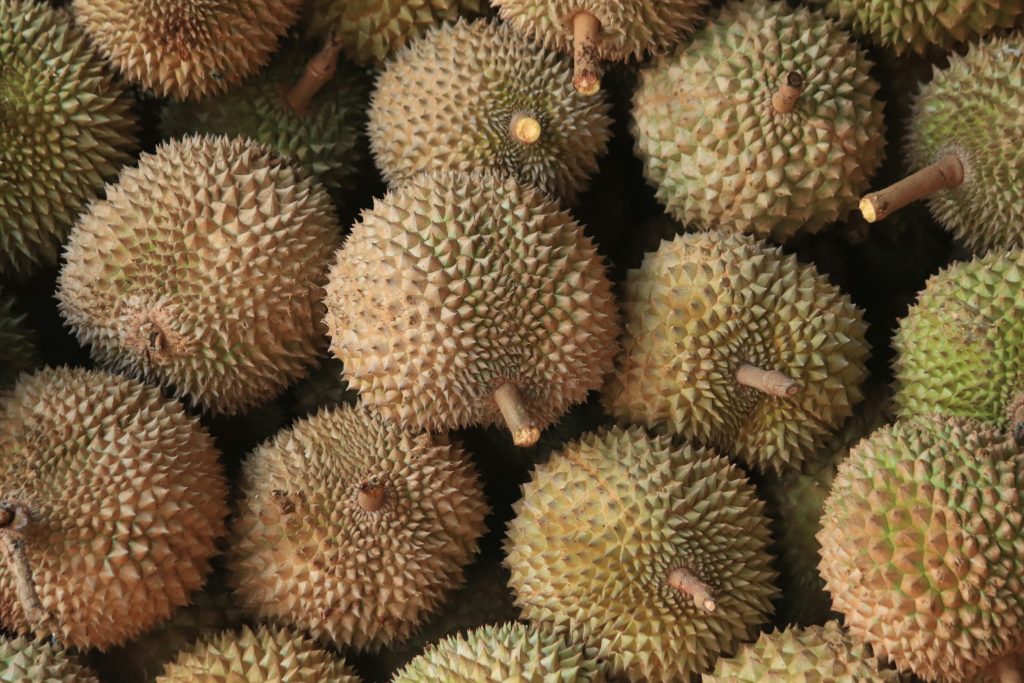
Durian, the so-called ‘king of the fruits’, is not the easiest fruit to love.
The earliest known European reference to it, as outlined by John Charles Ryan, is Venetian merchant Niccolò de’ Conti’s account of his travels to Southeast Asia in the 1430s, in which he describes durian as “one of the most highly esteemed fruits of the Malay Islands, but extremely offensive to those who are unaccustomed to it, on account of its nauseous odour”.
Some varieties are easier to enjoy. Thai durians, for instance, are sweeter, milder, and more consistent – ideal for beginners. Not surprisingly, the Food and Agriculture Organization reports that more than 90% of global durian exports come from Thailand.
Malaysia’s Musang King, widely considered a “premium” durian, is highly sought after in China. With its buttery, bittersweet flavour and creamy consistency, it appeals to more experienced palates without being overwhelming.
Why Indonesian wild durian is different
Indonesia, however, wins on diversity. For those who enjoy bold, challenging, unpredictable flavours – with hints of sub-alcoholic fermentation – Indonesian wild durian is arguably the best in the world.
These durians come with a warning: not for the faint-hearted.
This matters because Indonesian durian is no longer just a local obsession or a regional curiosity. It is now entering one of the world’s most lucrative fruit markets: China.
Bawor, Supertembaga, and ‘local’ durian
Like wild honey or mushrooms, wild durian varies in shape, size and flavour.
Indonesia’s standout variety is the Bawor, from the Banyumas region in Central Java. Its flavour profile is relatively accessible: sweet, creamy and mild, yet often fermented enough to carry a slight alcoholic edge. Consumed in large amounts, it can even lead to mild inebriation.
For more adventurous durian aficionados, the Supertembaga (‘Super-copper’) from Bangka Island is even more challenging. Its deep gold or copper-orange colouring masks a flavour that is sweet, bitter, and often strongly fermented, especially when over-ripe.
Durian lokal, or ‘local’ durians from Kalimantan, Sumatra and West Java, push the boundaries of diversity even further, offering some of the most intense flavours in the archipelago. The best are characterised by small seeds and large, fleshy segments.
Indonesia enters the China durian market
Indonesia’s durian industry is now attracting global attention.
Long confident in the diversity and quality of its durian, Indonesia has entered the race to export to China, the world’s largest and fastest-growing durian market. In 2025, Chinese durian imports reportedly surged to a record high of nearly US$7.5 billion, up from US$3.3 billion in 2021-22.
In late 2025, Indonesia gained market access to export frozen durian to China. This has triggered rapid expansion of durian plantations, raising environmental concerns.
Environmental risks behind the export boom
Conservationists warn that further forest conversion for durian farming could damage ecosystems already under pressure from decades of deforestation. A comparable trend has emerged in Malaysia, where rising demand from China has driven forest clearing for large-scale monocrop plantations devoted to the premium export cultivar (Musang King), resulting in a range of social and environmental consequences.
Access to China offers major economic opportunities for Indonesian farmers, who typically operate small orchards. But it also brings responsibility: to manage growth sustainably, protect ecosystems, and mitigate the impact of climate change.
These challenges are partly economic, partly ecological, and deeply shaped by local practices and human interactions.
Why anthropology matters
How best to understand all of this? Given the complexity, anthropology is valuable.
Using principles of critical anthropology, researchers can interpret, reveal and contextualise the lived experiences embedded within Indonesia’s durian supply chain.
This includes documenting the behaviours and perspectives of key actors across the supply chain, from farmers and processors to exporters, regulators, and consumers, each operating within broader social, economic, and political systems.
These perspectives can reveal rarely told stories.
The human stories behind the supply chain
For example, government negotiations to secure market access to China – covering quality assurance, traceability, and certification – remain largely undocumented. What happens when shipments are delayed or rejected because of missing or incorrect documentation? Who resolves these issues, and who bears the cost – the exporter or the importer? What reputational risks might the Indonesian government face?
Alternatively, insight can come from Indonesia’s army of durian-related digital content creators, who show remarkable agency and creativity in how durian is grown, harvested, marketed and consumed. These clips may not always offer deep analysis, but they are extremely addictive.
– Marshall, Brisbane, May 2026