
Introduction
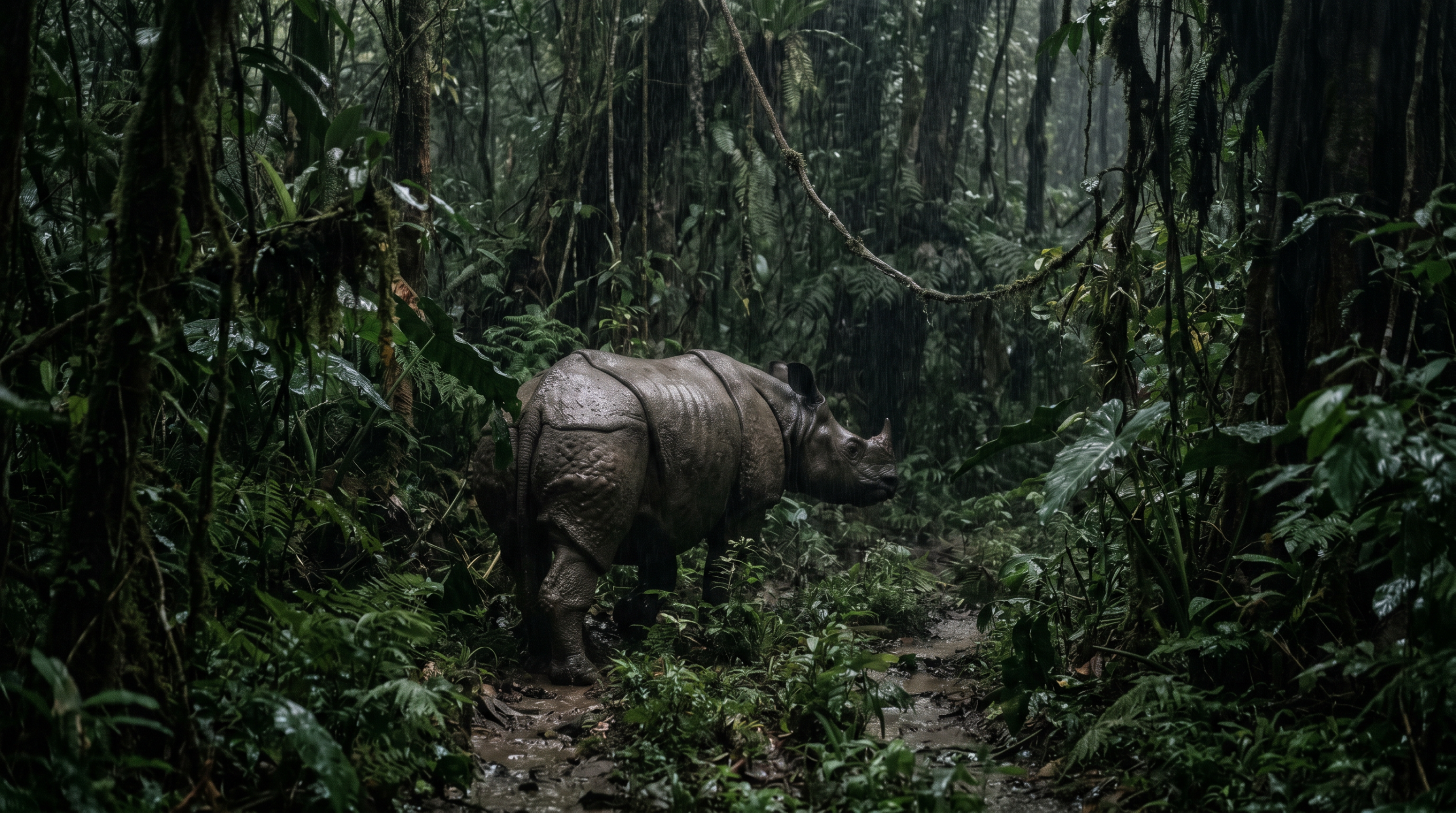
The Javan rhinoceros (Rhinoceros sondaicus) is one of the rarest large mammals on Earth and is listed as critically endangered on the International Union for Conservation of Nature (IUCN) Red List. This raises a difficult question: why has one of the world’s rarest large mammals become so vulnerable despite decades of conservation attention?
Its decline exemplifies what environmental humanities scholar Rob Nixon describes as ‘slow violence’: a form of destruction that unfolds gradually and out of sight. Unlike spectacular disasters such as burning towers, avalanches, volcanoes or tsunamis, slow violence occurs quietly, incrementally and continuously over long periods.
For the Javan rhino, around 50 individuals remain, all in one isolated location: Indonesia’s Ujung Kulon National Park on the western tip of Java.
Extinction is not arriving as a single dramatic event. Rather, it is unfolding slowly through habitat loss, poaching, invasive species, commercial pressures and political decisions that make an already fragile species even more vulnerable.
Like many endangered species in the modern world, the Javan rhino is being pushed towards extinction by the accumulation of environmental pressures over many decades, if not longer.
Habitat destruction and historical decline
As a lowland species, the Javan rhino depends on lowland rainforest habitat, which is among the most heavily exploited on Earth.
Historically, illegal logging, deforestation and clearing forests for agriculture and palm oil plantations dramatically reduced the rhino’s habitat, eventually confining the species to Ujung Kulon National Park by the 1930s.
Even within Ujung Kulon, habitat remains limited. Only about half of the park is suitable rhino habitat, raising concerns about carrying capacity, inbreeding and genetic erosion.
Poaching, scarcity and vulnerability
Like all rhinoceros species, the Javan rhino’s decline has been accelerated by hunting and poaching.
Colonial hunters killed many hundreds of rhinos in the 18th and 19th centuries, while more recent poaching has been driven by the black-market trade in rhino horn. Because the Javan rhino is so critically endangered, its horn has become extremely valuable on the black market. This reflects what ecologists call ‘Allee effects’: as a species becomes rarer, its economic value rises, encouraging even more poaching.
Between 2019 and 2023, poachers associated with organised criminal networks killed 26 Javan rhinos – about one third of the population.
Invasive species and ecological pressure
Another major threat to the Javan rhino is the spread of the invasive Arenga palm (Arenga obtusifolia) across Ujung Kulon National Park. The palm forms a dense canopy that blocks sunlight from reaching smaller vegetation favoured by the rhinos, reducing food availability and disrupting the wider ecosystem.
Conservationists have also raised concerns about increased human activity near the rhino habitat.
Although Ujung Kulon National Park is a protected area, the Indonesian government recently allowed lobster fishing to resume along parts of the coastline surrounding the park, following the lifting of a previous ban. Park officials warned that an influx of fishers and motorised boats could threaten the rhinos’ fragile habitat.
Reports also emerged that lobster export licences were granted primarily to companies with close ties to the fisheries minister who reversed the earlier ban.
In this sense, the pressures facing the Javan rhino are not purely ecological. They are also shaped by political and economic decisions that prioritise short-term commercial activity over long-term environmental protection.
The difficulty of establishing a second habitat
In response to these pressures, Indonesian conservation authorities and international organisations have increased anti-poaching patrols, habitat restoration programs and monitoring throughout the park.
In addition, calls to establish a second habitat outside Ujung Kulon – where rhinos would be less vulnerable to natural disasters and poaching – have persisted for more than thirty years. However, they have been on hold since the first attempted translocation of a male rhino ended with his untimely death within hours of capture.
What extinction reveals about slow violence
Ultimately, the story of the Javan rhino is not simply about one endangered animal in Indonesia. It reflects a broader pattern of slow environmental violence across the modern world, in which ecosystems are gradually degraded by deforestation, commercial exploitation, invasive species and political decision-making.
The extinction of species such as the Javan rhino rarely occurs suddenly. More often, it is a disaster unfolding over years, decades, even centuries – one of those forms of environmental harm that Rob Nixon (2011, p. 3) describes as “slow moving and long in the making, disasters that are anonymous and star nobody”.
The loss of the Javan rhino would matter. As science writer Justine E. Hausheer argues, every species has a moral right to exist, and without them, the world would be less spectacular.
The challenge, then, is not only to protect endangered species but also to tell their stories in ways that expose slow forms of environmental harm and make them harder to ignore.
– Marshall, Brisbane, May 2026