
Introduction
It is not easy to be the world number one in anything. Just ask Björn Borg, Steffi Graf, Roger Federer, Rafael Nadal, Serena Williams or Novak Djokovic, who have devoted their lives to it.
For these tennis greats, becoming world number one was the result of rare talent, relentless discipline and a drive to win as many matches and tournaments as possible.
But what does it mean for a country to be the world’s best at something?
National dominance is a strange thing
There are no clear guidelines. Some countries become associated with particular forms of excellence almost by accident: Brazil and Argentina with football, China with table tennis, Kenya and Ethiopia with distance running, India with cricket, and Mongolia with traditional and contemporary throat singing.
Most of these stories seem almost accidental. Egypt’s story, however, is more deliberate.
A squash system built over decades
Egypt’s rise to global supremacy in one sport – squash – is remarkable. In 2026, Egyptian players continue to dominate the professional rankings, with Egyptians at or near the top of both the men’s and women’s games.
This is not a recent phenomenon. For decades, Egypt has produced a steady stream of squash champions in both the men’s and women’s categories, many of whom are household names in the sport: Ramy Ashour, Mohamad El Shorbagy, Ali Farag, Tarek Momen, Karim Abdul Gawad, and the current world number one, Mostafa Asal. At the time of writing, Hania El Hammamy, Nour El Sherbini and Amina Orfi sit at the top of the women’s rankings, while Egyptian players also feature heavily in the men’s top 20.
Egypt’s dominance did not happen by accident. It emerged from a sporting ecosystem shaped by colonial-era courts, national heroes, state support, elite clubs, corporate sponsorship and a distinctive playing style.
From colonial courts to Egyptian champions
It didn’t start out this way. After its invention at a British prep school in the 19th century, the sport spread throughout the British Empire, including Egypt. The British built clubs for their colonial officials in Cairo and Alexandria, granting Egyptian ball boys and service staff access during off-hours.
Something clicked in the 1930s, when an Egyptian diplomat discovered squash in England and, after becoming so skilled, won the British Open – the leading tournament at the time – six consecutive times. He proved that Egyptians could be the world’s best at a sport invented by their colonial rulers.
State support, spectacle and the pyramids
In the 1990s, the charismatic Ahmed Barada became a world champion, inspiring a generation of young Egyptians – especially those from the middle class – to take up squash. More importantly, the then-president, Hosni Mubarak, a recreational squash player, committed state resources to elevate the sport’s status.
Mubarak oversaw investment in clubs, coaches and major tournaments with substantial prize money, helping to professionalise the sport and raise its profile.
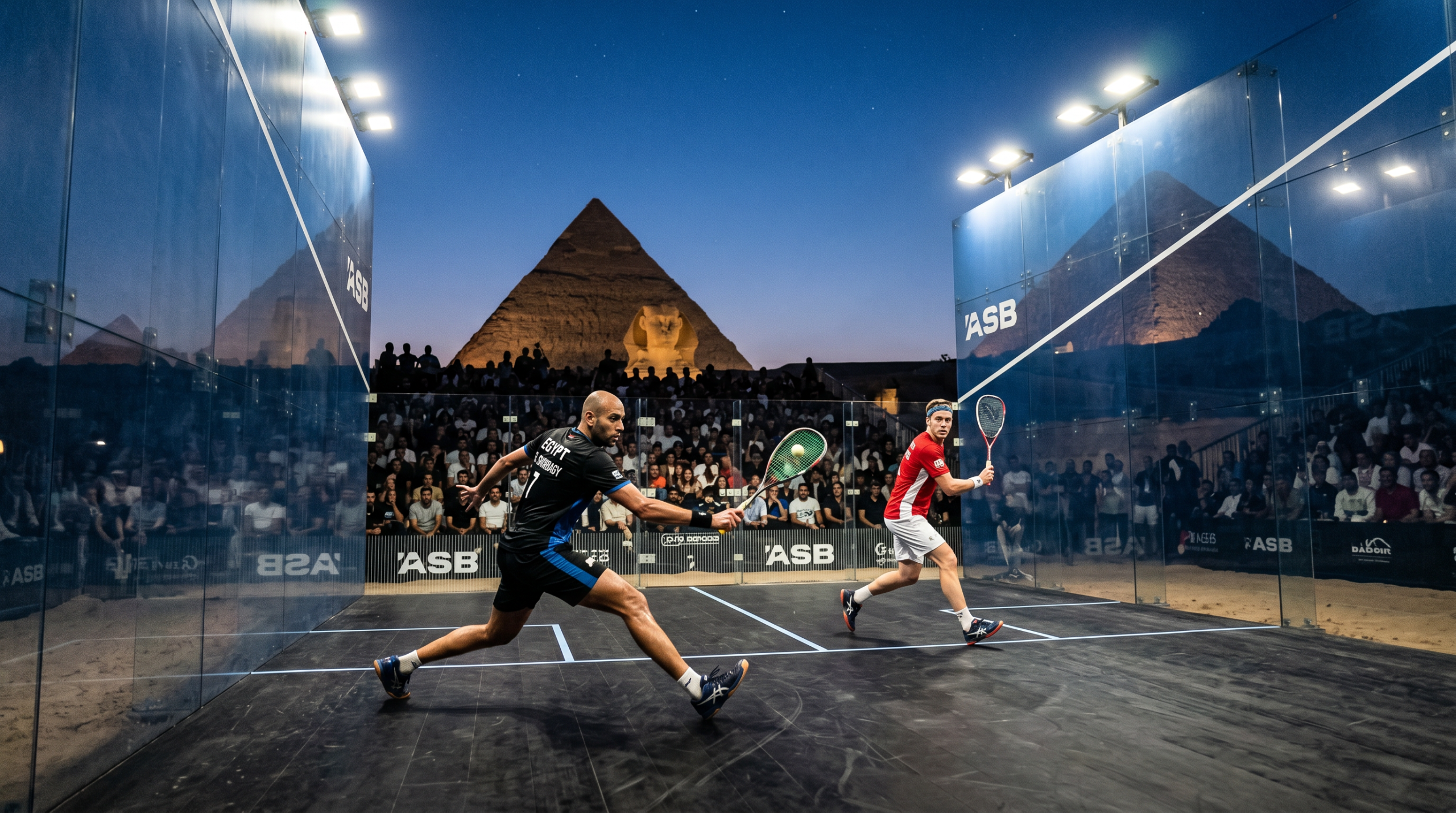
Since 1996, the Egyptian Open, held in a glass court in front of the Great Pyramids of Giza, has become one of the sport’s most prestigious tournaments.
The ecosystem behind Egypt’s dominance
We now have a sustainable squash ecosystem, with strong clubs, family involvement, corporate sponsorship, and a deep talent pipeline. Egyptian players have even developed a distinctive playing style characterised by aggression, creativity and flair.
This is all very interesting, but what does it mean?
As Egypt’s pyramids show, being the world’s best at something is rarely accidental.
– Marshall, Brisbane, April 2026