
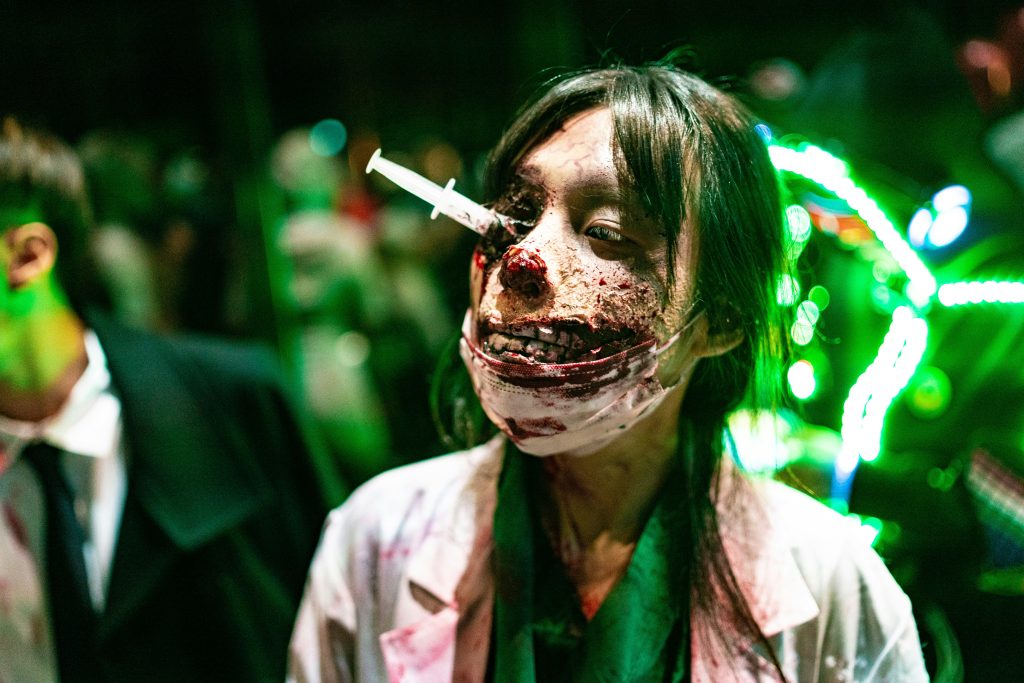
South Korea’s biggest cultural exports on the world stage include three things: Squid Game, “Gangnam Style” and zombies.
The latter are among the world’s most terrifying for one key reason: their extraordinary speed, sustained across an impressive and growing body of film and television.
But speed is just one element. South Korean zombie films and dramas have also pushed the genre towards darker territory, introducing new behaviours, historical settings and a heightened sense of collective catastrophe.
South Korea’s terrifying zombie exports
In Train to Busan (2016) and its sequel Peninsula (2020), both directed by Yeon Sang-ho, the undead are portrayed as a fast-moving, collective threat, in contrast to the slow, shambling zombies that dominate much of the genre.
Such is their urgent, voracious hunger for human flesh that they seem to hurl themselves through the air, clambering over one another and onto the living in bursts of frantic, hyper-kinetic energy. Similar depictions appear even in relatively slow-paced zombie works, such as Happiness (2021), a K-drama directed by Ahn Gil-ho.
This emphasis on feral aggression is not confined to contemporary settings either.
Films and TV series such as Rampant (2018) and Kingdom (2019), both directed by Kim Sung-hoon and set in Korea’s Joseon dynasty (1392-1910), extend this approach to historical drama, suggesting a consistent pattern in Korea’s impressive contribution to the genre.
Beyond the Hollywood zombie template
Of course, fast zombies are not unique to Korea. Rage-fuelled, sprinting zombies first appeared in Danny Boyle’s 28 Days Later (2002), soon followed by Zack Snyder’s Dawn of the Dead (2004), popularising the shift from slow to fast zombies in mainstream cinema.
By the time the film version of World War Z was released in 2013, the speedy zombie had become part of the canon.
What makes Korean zombies distinctive, then, is not speed alone. It is the way Korean filmmakers have intensified, adapted and reworked the zombie template across film, television and historical drama.
What Korean zombies add to the genre
You would have thought that fans of the genre would understand that, while Korean zombies are super-kinetic, they are not entirely unlike fast zombies depicted elsewhere.
But the comments under trailers for the upcoming Colony, directed by Yeon Sang-ho of Train to Busan fame, suggest something more is going on.
“Korea does zombies better,” one writes. “It’s clear that Koreans are taking the zombie genre to amazing new levels,” says another. A third is telling: “Korean zombies are the most terrifying zombies, ever. I love it!”
Korean zombies, more than any other variant of the undead, have earned a reputation for their hell-for-leather behaviour.
But Korea has also contributed distinctive additions to the genre’s global lore, including the emergence of nocturnal zombies in Rampant and Kingdom.
In Train to Busan and the upcoming Colony, the fast zombies show signs of a hive mind, a trait usually reserved for slow-moving undead. In the K-drama with zombies, Happiness, we encounter another radical behavioural variation: the infected can return to their normal, human state, albeit with a terrible migraine.
Social and political undercurrents in the shadow of North Korea
Korea has also expanded the genre thematically.
According to Kim Hyeong-seek, a cultural studies scholar, one key aspect of the Korean take on the genre is its focus on how the undead – or more specifically ‘Patient Zero’ – came to be: “They imagine impoverished populations on the margins falling victim to a viral epidemic – not unlike today’s world”.
In Kingdom, he explains, starving peasants in war-torn Joseon-dynasty Korea turn into zombies after unknowingly eating human flesh. In the 2016 animated film Seoul Station, patient zero is a homeless man ignored by passing commuters.
“In other countries, it’s about how quickly you kill the zombies. That’s not necessarily the case for Korean zombies. You feel for the zombies and lament the humans keeping them out,” Kim said.
The elephant in the room at this stage is why zombies are so ubiquitous in Korea. This may sound flippant, but if your nearest neighbour were North Korea, wouldn’t you also be inclined to imagine the worst?
– Marshall, Brisbane, July 2026