
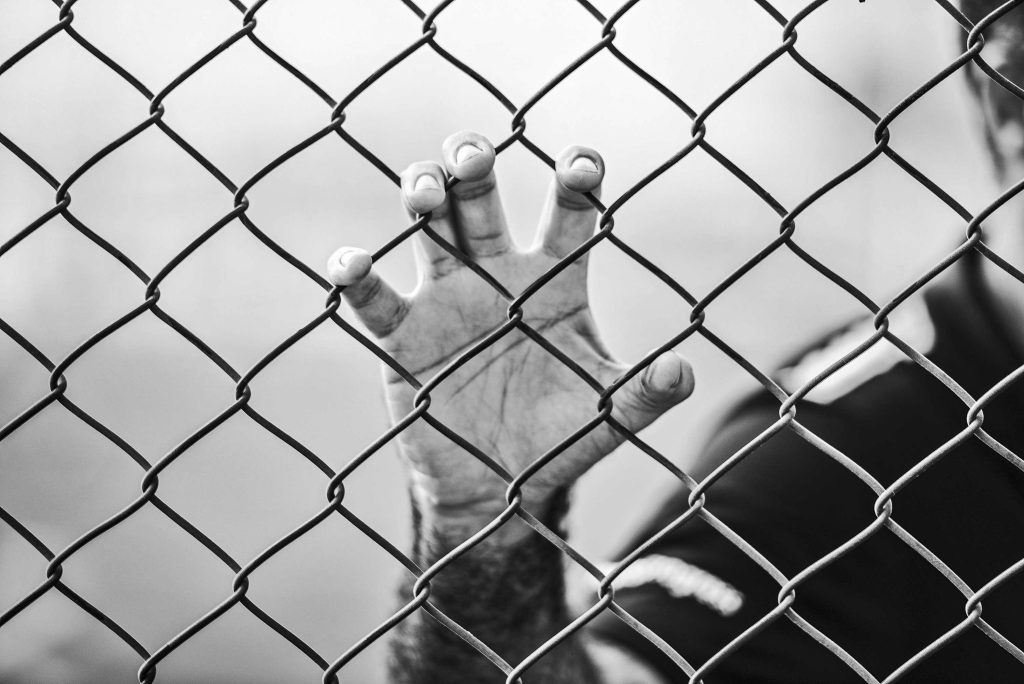
Depictions of prison life explore timeless themes, such as crime and innocence, punishment, incarceration, survival, freedom, and redemption. Perhaps this helps explain why prison stories remain so compelling across film, television and literature.
The Shawshank Redemption and Prison Break
The Shawshank Redemption (1994) has consistently been voted the best film ever made. Based on Stephen King’s novella Rita Hayworth and Shawshank Redemption (1982), the film tells the story of banker Andy Dufresne (Tim Robbins), who is sentenced to life in Shawshank State Penitentiary for crimes he did not commit.
Similarly, Prison Break (2005-9, 2017) is widely considered one of the best TV shows ever made. It tells the story of a genius structural engineer, Michael Scofield (Wentworth Miller), who deliberately gets himself sent to Fox River State Penitentiary to break out his innocent brother from death row. One comment on the Season 1 trailer says it all: “Every minute of this whole series is absolutely engaging. Never gets old, never gets boring.”
Prison Break in Space
Meanwhile, the Star Wars franchise has seen many remakes and reboots in recent decades.
Yet only one series, Andor (2022-25), has earned widespread critical acclaim, largely thanks to its thrilling “prison break in space” episode arc.
Beyond the prison yard
The French thriller A Prophet (2009), set in a Marseille prison, is also remarkable. It tells a brutal coming-of-age story set amid interactions among the prison’s Corsican, Arab, and African inmates.
A raw, affecting reboot, A Prophet: The Series, has also appeared in recent months. Like the original film, the TV series extends beyond the prison setting, offering sharp insight into immigration and race relations in contemporary France.
Prison through the lens of fiction and memoir
Some of the world’s greatest authors have also revealed the realities of prison life from the inside.
Russian Nobel Prize-winning novelist Aleksandr Solzhenitsyn powerfully depicted his firsthand experience of the Soviet Union’s forced-labour camp system in One Day in the Life of Ivan Denisovich (1962) and The Gulag Archipelago (1973).
Similarly, Indonesian novelist Pramoedya Ananta Toer drew on his imprisonment without trial in the remote Buru Island labour camps from 1969 to 1979 for The Mute’s Soliloquy (1999).
The best-selling memoir Papillon (1969) also draws on French writer Henri Charrière’s experiences of repeated imprisonment and escape in the penal colonies of French Guiana, including the infamous Devil’s Island.
The panopticon
Michel Foucault’s Discipline and Punish: The Birth of the Prison (1975) is relevant here because it predicts not only the fascination with prison but also how the forms of power that operate in prisons are readily apparent in everyday life.
In prisons, Foucault argues, the regimentation of prisoners’ behaviour occurs behind closed doors, and every action is observable not only to the prison wardens but also to fellow prisoners. The paradigmatic example is the model prison, or “panopticon”, imagined by 19th-century philosopher Jeremy Bentham. A “panopticon” is a circular prison arranged around a central watchtower, from which the wardens can see in all directions.
As Matthew Sharpe explains in The Conversation, “This design works because the prisoners know they are always observable – even if there is no one actually watching in the central tower. Prisoners are prompted to internalise the gaze of their keepers and to “watch themselves”, lest they err.”
The Algorithm
Nowadays, similar forms of power operate invisibly in classrooms, public buildings, open-plan offices and even sports arenas. Surveillance cameras proliferate in suburbs and cities, epitomised by football’s much-maligned Video Assistant Referee (VAR). Speed cameras have such a psychological effect that the camera doesn’t even need to be turned on: the possibility of it being on is enough to ensure drivers obey the speed limit.
The biggest contemporary prison is probably your social media algorithm, recording and collating your every mouse click, predicting what content will interest you. Ironically, your previous social media behaviour may well have led you here today.
– Marshall, Brisbane, September 2026